For centuries, accounts of children offered to the mountains belonged to the realm of legend. These stories were difficult to believe because the ritual sites were so hard to reach. Then, in 1999, three of those children were found.
For a long time, the Children of Llullaillaco were one of those stories suspended between belief and doubt. Ancient chronicles described children chosen by the Inca Empire, taken to distant mountains and offered in ceremonies that linked Cusco to the farthest reaches of Tawantinsuyu. There were accounts. There were ruins. Yet, for those looking back on this past centuries later, something was still missing that could turn the narrative into a tangible fact.
It was not a legend in the strict sense. The ceremony appeared in colonial documents, and mountaineers had already reported pre-Columbian structures on the slopes of Llullaillaco. Even so, no one knew that three children remained there, hidden beneath stone, cold and silence, at one of the most extreme altitudes ever reached by a human ritual.
In March 1999, however, the story changed. An expedition found an adolescent girl and two younger children near the volcano’s summit, accompanied by textiles, food, pottery and miniature figures. What had seemed to belong only to the realm of extraordinary stories now had faces, names and questions that were impossible to ignore: why take children to the top of a mountain? How did they reach a place where the air is thin and the cold is extreme?
The answer does not begin with the expedition. It begins with the Andean way of understanding the world.
Before looking for the children, we must understand the mountains
For travelers today, an Andean mountain may be scenery, a sporting challenge or a geographical feature. For many Andean societies, however, it could be all of these and much more. Certain mountains were regarded as gods, presences capable of protecting, nourishing and ordering life, while also demanding reciprocity and sacrifice.
This is the context in which apus and huacas appear. These terms do not describe a single religion practiced in the same way by all the peoples of the Andes. They help us understand a landscape in which mountains, springs, rocks, ancestors and ceremonial sites could hold power and take part in human life.
In the Atacama, this relationship was never abstract. The water that makes it possible to cultivate crops, raise animals and remain in the desert comes from the mountains. Snow, summer rainfall and waterways descending from the Andes connect the highest elevations with the oases and the communities established in these regions. Looking at a volcano, therefore, also meant looking toward the source of the water that made life possible.
This order was sustained by reciprocity. Food, textiles, metals, animals and other goods could be offered to renew bonds with these sacred forces. Offerings had value because they removed something important from the human world and delivered it to another realm. Within this logic, the greater the event, the greater the value of the offering could be.
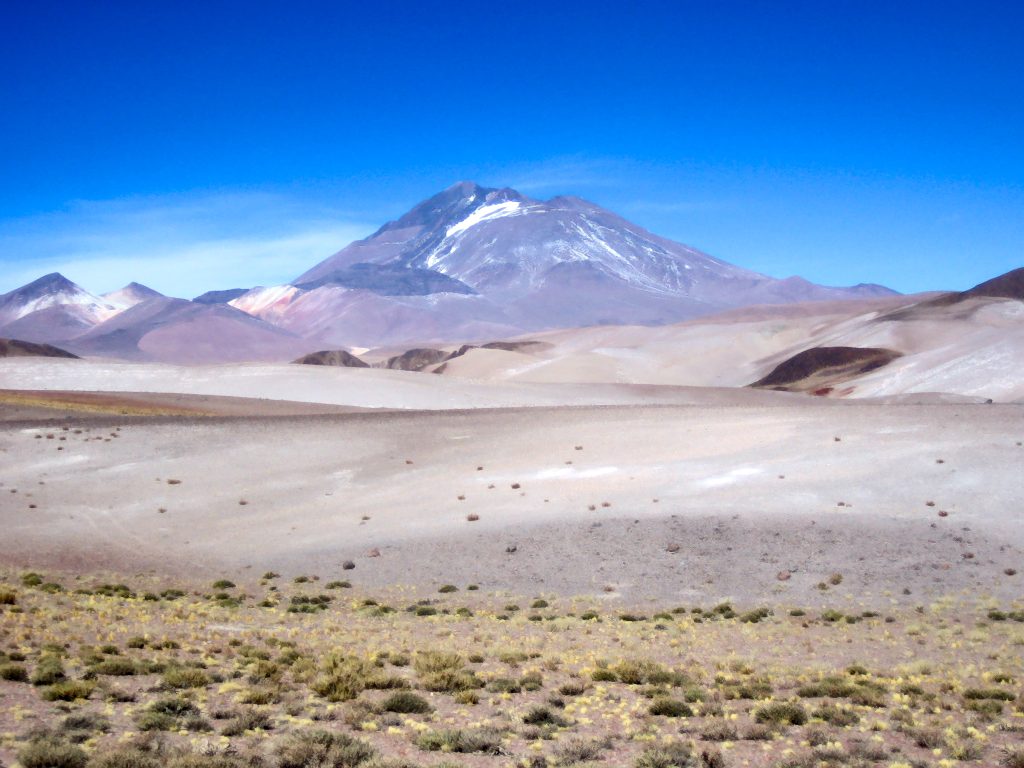
Llullaillaco volcano, Provincia de Salta (Argentina). Photo: Lion Hirth
Capacocha: a journey between the center of the empire and the sacred world
The ceremony that helps explain the Children of Llullaillaco was known as capacocha, also spelled Qhapaq Hucha. It could take place at important moments for the Inca state, such as successions, crises, conquests, calendar celebrations or events believed capable of altering the balance between society and the sacred.
Children selected in different provinces were taken to Cusco and then sent to distant shrines. Their journey followed roads, settlements and administrative centers connected by the Qhapaq Ñan. The procession therefore united religion and politics: as it reached the mountains, it also demonstrated how far the empire’s authority extended.
For the Incas, these children were not simply being “left behind.” They were believed to ascend to the realm of sacred beings and to serve as intermediaries among communities, ancestors and mountain deities. This was how the ritual was understood within that world.
Understanding, however, does not mean justifying. From a contemporary perspective, capacocha was also a form of violence carried out by a state against very young people. Reducing it solely to irrational cruelty disregards the worldview that gave it meaning. Presenting it as a sacred, beautiful and pure ceremony erases the importance of the children and young people delivered to the mountains as offerings. Both dimensions must therefore be considered.
It is also important not to attribute capacocha indiscriminately to the peoples of the desert. The expansion of the Inca Empire reached territories inhabited by populations with their own histories and practices, including the Licanantay. Mountains such as Licancabur and Cerro Quimal contain evidence of high-altitude rituals, but not of known human sacrifices. Llullaillaco belongs to an Inca state ceremony conducted within an Andean and Atacama landscape that had already been sacred long before the empire.
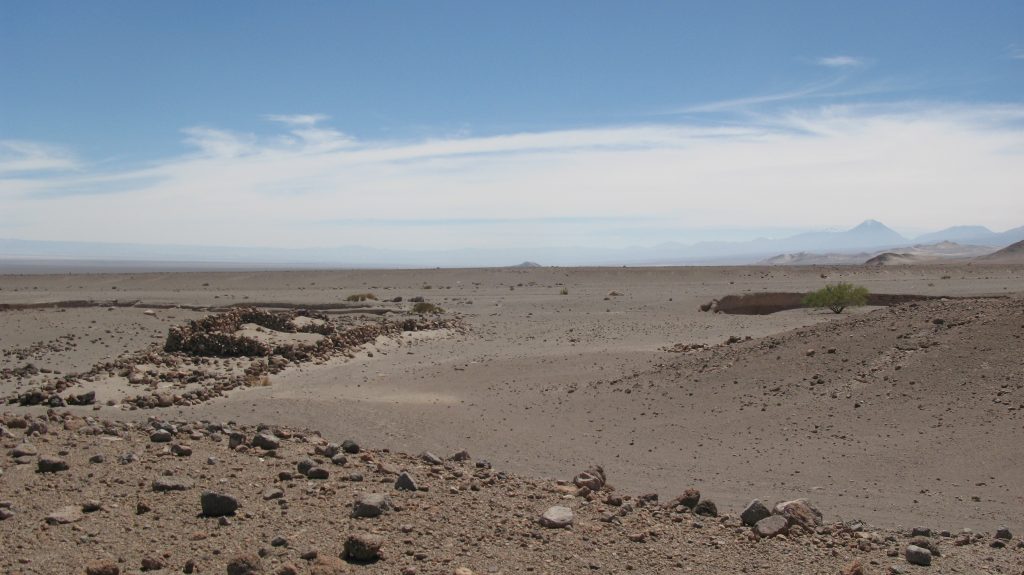
Tambo de Camar, Ruta del Capricornio, Municipality of San Pedro de Atacama. Photo: Servicio Nacional del Patrimonio Cultural.
There were traces and evidence, but the secret remained buried
Chroniclers from the colonial period recorded the existence of capacocha. Centuries later, explorers and mountaineers found paths, shelters and ruins on mountains that seemed impossible to reach or inhabit. On Llullaillaco, structures near the summit already indicated that someone had transformed this remote place into a shrine.
This means that the 1999 expedition was not pursuing a legend entirely unsupported by evidence. It followed archaeological traces, previous experience and accumulated knowledge about high-altitude shrines. In this particular case, the mystery was different: what might still remain beneath the ceremonial platform?
The answer lay more than 6,700 meters above sea level. At this altitude, constant cold, low humidity and thin air interrupted many of the natural processes of decomposition. The mountain preserved more than objects. It preserved people.
In 1999, the mountain answered
In March of that year, an expedition led by archaeologists Johan Reinhard and Constanza Ceruti worked near the summit of Llullaillaco, on the border between Chile’s Antofagasta Region and Argentina’s Salta Province. The volcano reaches 6,739 meters and dominates part of the Puna de Atacama, a region of salt flats, wind and extreme temperature variations.
First came the signs of the ceremony. Then came the burials. There they found La Doncella, an adolescent girl approximately 13 years old, and El Niño and La Niña del Rayo, two younger children. The latter received her name because a lightning strike hit the site and burned her face and part of her body centuries after her burial.
Around them was a miniature world: human and animal figures, metal objects, shells, pottery, food and textiles made with raw materials from different regions. Nothing suggested an improvised act. Bringing everything to the summit required the mobilization of people, knowledge, routes, shelter and resources across great distances.
This is precisely why the Llullaillaco discovery had such an impact. The three children brought the Inca era closer to the modern age. On one side were ancient accounts of capacocha. On the other, modern archaeology had found a ceremony preserved with a clarity that no colonial text could provide.
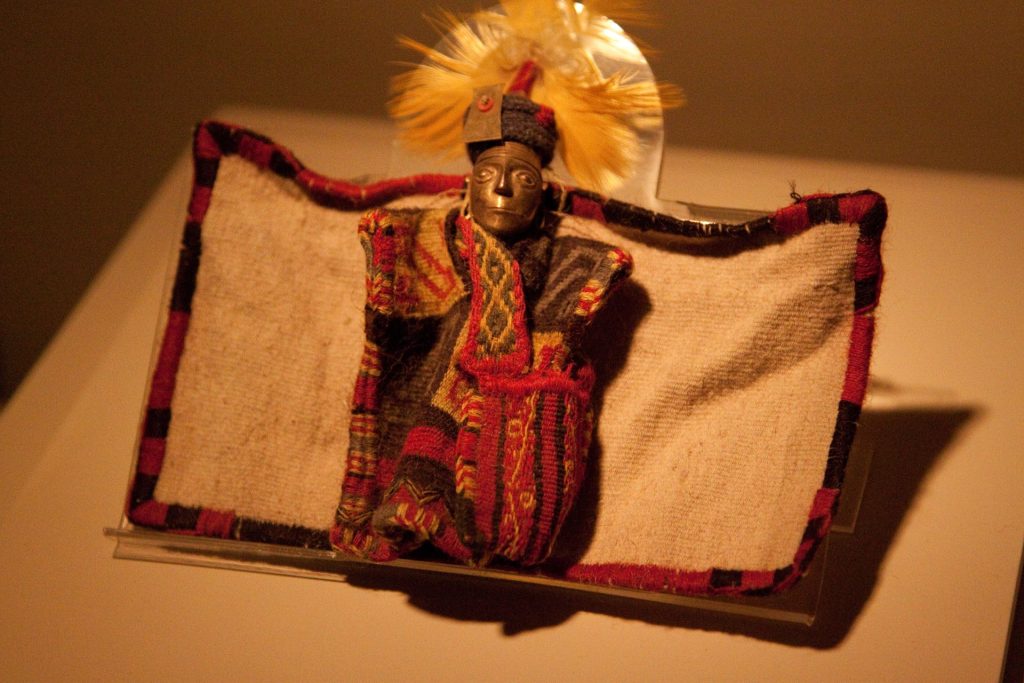
Grave goods found with the Children of Llullaillaco. Photo: jimmyharris.
Who were the Children of Llullaillaco?
The names by which the three children became known are modern. Their original identities, unfortunately, have been lost to us. Even so, their clothing, hairstyles and objects reveal parts of their stories and indicate that each occupied a distinct position within the ceremony.
La Doncella was the oldest and underwent a different preparation from the two younger children. El Niño was the only boy in the group. La Niña del Rayo bears the marks of the lightning strike that reached her burial site long after the ritual. Together, they show that capacocha did not unfold as a single experience repeated identically in every case.
Today, all three are in the care of the Museo de Arqueología de Alta Montaña in Salta, known as MAAM. Only one is displayed at a time, on a rotating basis and under controlled conservation conditions. This alternating display asks visitors to change the way they look at the children: they are not curious objects from a distant past or characters in a horror story. They are people who carry the cultural heritage of an ancestral empire.
National Geographic turned the discovery into documentaries
The discovery reached the public almost as quickly as it reached researchers. Ice Mummies, a National Geographic TV production released in 1999 and also listed as Ice Mummies: Frozen in Heaven, used footage from the expedition to show the world what had been found on Llullaillaco.
In 2002, the special Inca Mummies: Secrets of a Lost Empire revisited footage of the discovery within a broader narrative about the Inca world. Later, Child Mummy Sacrifice, released in 2009, followed the scientific research conducted on the three children.
Taken together, these productions record an interesting shift. The first centers on the discovery. The second broadens the context. The third asks what the bodies and objects might reveal. A story that had once seemed distant was no longer merely being recounted. It was beginning to be examined thread by thread.
What science deciphered in the silence of the ice
The hair of the Children of Llullaillaco preserved a chemical timeline. By analyzing it, researchers identified changes in their diet and in their consumption of coca and fermented beverages during the months before the final ascent.
In La Doncella’s case, her diet changed about a year before the ceremony and began to include more foods associated with elites, such as maize and animal protein. Her coca consumption increased months later, while alcohol consumption intensified closer to the end. The two younger children followed different paths.
Coca and fermented beverages had social and religious functions in the Andean world. In the context of Llullaillaco, they may also have reduced the perception of cold, anxiety and resistance. The analyses point to a long, controlled preparation rather than a sudden event.
There is, however, a boundary that no technology can cross. Science can describe changes in diet, the difficulties of the journey, the children’s health and the substances preserved in their bodies. It cannot reconstruct what each child thought, understood or wanted. What the ice preserved is extraordinary. What it did not preserve remains part of the mystery.
Other children between the Atacama and the high mountains
Llullaillaco was not an isolated case. Other shrines in the southern Andes held the remains of children and young people associated with capacocha. There is, however, a geographical distinction often lost in texts on the subject: not every discovery in the Atacama was made at high altitude, and not every high-altitude mummy was found in the Atacama.
- Cerro Esmeralda, in the coastal Atacama: A girl and a young woman were found near Iquique at approximately 905 meters above sea level. The site lies within the Atacama environment, but it is not a high-mountain shrine.
- Quehuar and Nevado de Chuscha, in the Puna of Salta: The remains of young people were identified at both sites in high-altitude Inca contexts. Quehuar rises above 6,100 meters, while Chuscha reaches 5,468 meters.
- Cerro El Plomo: The Niño del Cerro El Plomo was the first discovery of this kind. Found in 1954, he is one of the most important treasures held by Chile’s Museo Nacional de Historia Natural. He is particularly well known because he was found within the Santiago Metropolitan Region.
- Aconcagua, in the central Andes: The Niño de Aconcagua was found on 8 January 1985 by mountaineers climbing Aconcagua, the highest mountain in the Americas, in Mendoza Province, Argentina.
Llullaillaco brings both dimensions together. It stands in the Puna de Atacama and holds the highest known archaeological shrine, with three children preserved under exceptional conditions. This combination helps explain why its name has become inseparable from high-altitude archaeology.
Recent research on Cerro Esmeralda and Cerro El Plomo also reinforces that there was no single pattern for every capacocha. The ceremonies, the people selected and the preparation processes varied considerably. The empire had a ritual system, but that did not mean every story was alike.
The story lost its air of legend, but the mystery remains
The Children of Llullaillaco are often described as an extraordinary discovery because of their state of preservation. And they are. Yet the appearance of their bodies is only the first layer.
The discovery revealed the Incas’ ability to move people and objects across an extreme territory. It showed that religion and power traveled along the same roads. It also demonstrated that a mountain could bring together water, fertility, ancestry, political authority and contact with the divine in a single place.
It also forces us to live with a difficult history. Capacocha held religious meaning for those who performed it. At the same time, it was a human sacrifice that ended young lives. We do not need to choose between understanding the ritual’s context and criticizing the cruelty of human sacrifice. The most honest reading preserves both.
After learning about the Children of Llullaillaco, it is difficult to look at the volcanoes and mountains of the Atacama in the same way. They remain immense, beautiful and silent. But they cease to be merely scenery. They become part of a living territory, at the threshold of the divine and permeated by memories, beliefs, conflicts and power.
Visit the Qhapaq Ñan route in San Pedro de Atacama
We explore the legend and history of the Children of Llullaillaco on the Piedras Rojas and Altiplanic Lagoons tour. At the Tropic of Capricorn stop, the route crosses the Inca Road, the Qhapaq Ñan. You can see with your own eyes the road they followed toward their fate more than 500 years ago…
Plan your journey to the Atacama with context. Talk to the Atacama Connection team and discover a territory that goes far beyond its landscapes.
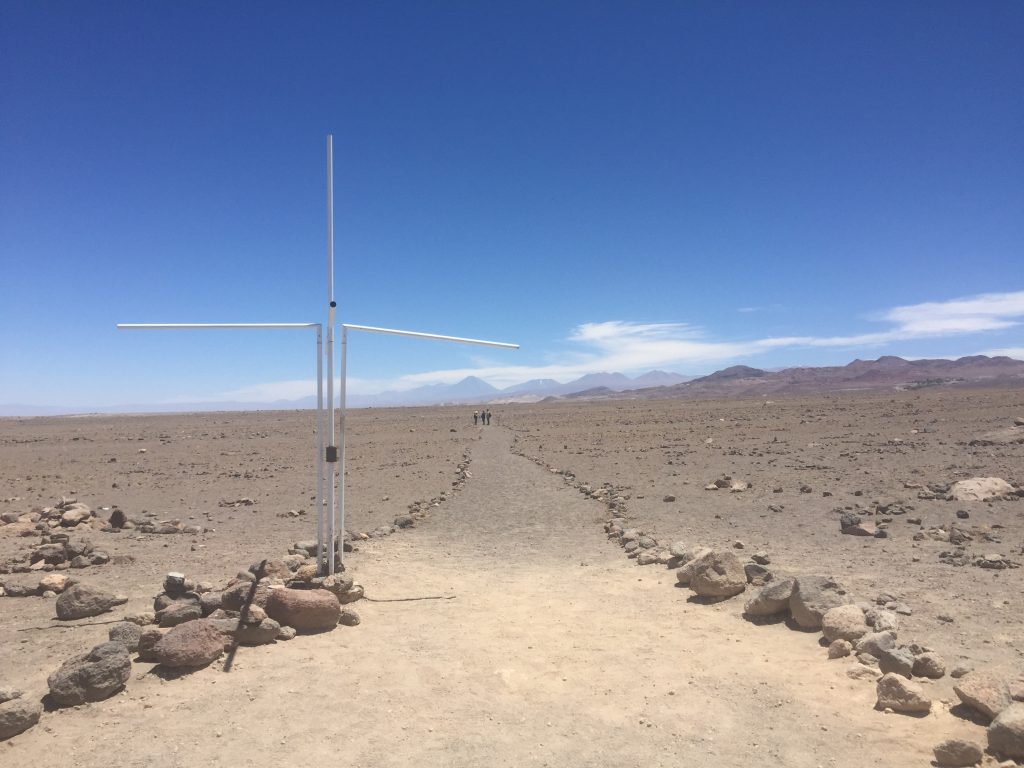
From the Tropic of Capricorn marker on the Qhapaq Ñan, Llullaillaco Volcano can be seen 200 km away in a straight line. Photo: Servicio Nacional del Patrimonio Cultural.
Read also
- The Licanantay people: water, agriculture, llamas and trade in the Atacama Desert.
- Patta Hoiri: the meaning of Mother Earth in Licanantay culture.
- Altitude in the Atacama: how to acclimatize before higher-altitude tours.
References and research sources
- Museo de Arqueología de Alta Montaña (MAAM): Colección Llullaillaco
- MAAM: Sala Llullaillaco e apresentação rotativa
- Wilson et al. (2013), PNAS: evidências arqueológicas, radiológicas e biológicas sobre as Crianças de Llullaillaco
- Wilson et al. (2007), PNAS: isótopos estáveis, DNA e sequência ritual
- Ceruti (2015): Frozen Mummies from Andean Mountaintop Shrines
- Silva-Pinto et al. (2026), Science Advances: Cerro Esmeralda e Cerro El Plomo
- Museo Nacional de Historia Natural de Chile: Niño del Cerro El Plomo
- Reinhard e Ceruti (2010): Inca Rituals and Sacred Mountains
- Johan Reinhard: produções de cinema e televisão sobre Llullaillaco
- National Geographic: Inca Child Sacrifice Victims Were Drugged
- NASA Earth Observatory: Llullaillaco Volcano e condições de preservação
- Bachraty (2021), Revista Chilena de Antropología: capacocha, El Plomo e santuários do sul andino
- Galería Qhapaq Ñan, Sistema Vial Andino, Región de Antofagasta
- Wikipedia: Momias de Llullaillaco